Exhibition
25 Nov 2022 - 15 Jan 2023
Friday, Nov. 25 to Sunday, Jan. 15 during regular museum hours (Friday-Sunday, 10 am – 5 pm).
Fort Calgary is closed from Dec. 23 – Jan. 5.
Fort of Dreams: Flipping the Narrative
A group of emerging artists from AUArts are lending their perspectives on some of Fort Calgary’s most familiar exhibits.
Ten intervention art pieces have been installed throughout the museum in an exercise that seeks to disrupt the expectations associated with the colonial history of museums.
Kay Burns, MA, MFA, artist and sessional instructor at Alberta University of the Arts (AUArts), is leading this interrogation of Fort Calgary’s current collection as part of her fourth-year course Critical Perspectives on Museums: Disrupting Institutional Structures at AUArts.
“The intent is for students to examine the work of Fort Calgary — what the stories there entail and what’s missing,” says Burns, who approached Fort Calgary with the sense that the museum would be responsive to a group of artists coming in to “essentially criticize their exhibits”.
The risk of scrutiny did not deter the Fort Calgary team from the partnership according to Adrienne Dewsberry, Fort Calgary collections and exhibitions specialist.
“The whole exhibition gives Fort Calgary an opportunity to work with different perspectives on our exhibit spaces that were built in the late 90s and early 2000s,” says Dewsberry. “Our current museum tells a great history of early Calgary and the history of Fort Calgary itself, but working on this intervention has helped us further examine the narratives we share and look for more of the stories we aren’t telling.”
Riel Starr, Red River Métis sculpting major, agrees the exhibition functions to broaden the Fort Calgary narrative and inspire questions about how institutions represent truthful histories.
“There’s not one canon of history,” says Starr. “We all have to collectively contribute our own histories to form a true history rather than one institution dictating what is presented as fact.”
WHAT TO EXPECT AND WHAT TO BRING (HEADPHONES!)
The 10 pieces cover a range of mediums, and while some are clear outliers from Fort Calgary’s collection, others are subtly integrated into existing exhibits. Visitors can follow along with a map marked with each intervention and use their phones to listen audio recordings of the artists describing their work and its relationship to the space.
Starr created didactic panels for the Red River cart and the octopus bag on display at Fort Calgary. The panels highlight what is missing in Fort Calgary’s presentation of the items.
“Fort Calgary doesn’t know the history of the (octopus) bag,” says Starr. “We don’t know who made it – who put their love into making the bag, which must have taken weeks or months. I’d really like people to begin questioning institutions. Is the full truth represented or is one truth represented? Is it colonial truth or Indigenous truth?”
Fourth-year drawing major Maxwell Fuselli chose one of Fort Calgary’s jail cells to hang his acrylic painting of a werewolf — an image Fuselli connects to his own queerness.
“In my research, I discovered the only real documentation about queer existence from the era when Fort Calgary was being used by the North West Mounted Police is in criminal records,” he says. “We were lumped in under the sodomy law — that put us in a position with awful, awful crimes.”
Fuselli says the creative process opened his eyes to the history of his own community, and he hopes his work will shed light on hidden histories of queer experiences for visitors as well.
Each piece in the exhibit investigates a different aspect of history — how it’s presented and how we understand it.
“You’d like to think that, if (visitors are) paying attention and engaging with the work, they’ll walk away from the museum asking a lot of questions and with a greater need for interrogation of what museums do and why they do it,” says Burns.
Read more at Fort Calgary.
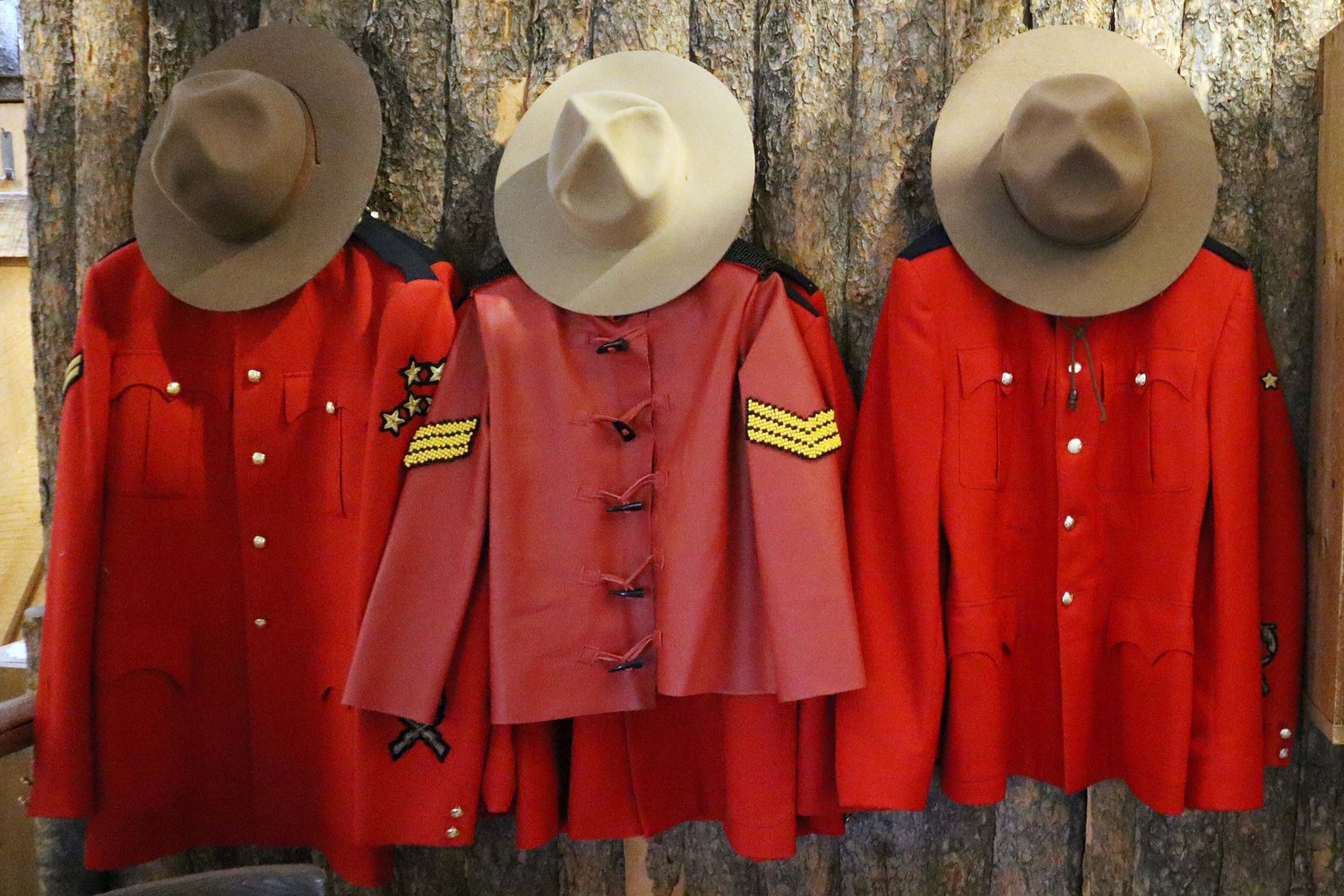
The Indigenous Mountie by artist Chloe Erickson, part of Fort of Dreams: Flipping the Narrative at Fort Calgary.