If you could step into a painting, you might imagine something grand—Renoir’s sunlit riverbank, da Vinci’s enigmatic mystery, Michelangelo’s divine spark, Emily Carr’s forest.
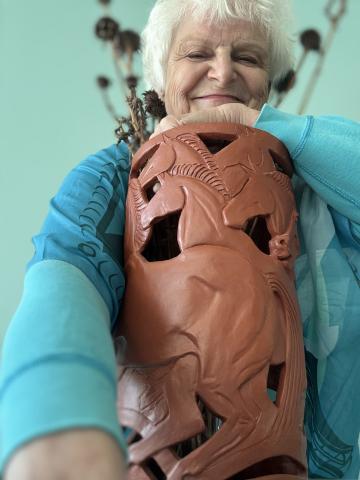
Nowhere on that list would be the split-level home of Monika Smith, BFA '08, Ceramics.
And yet, after a few hours inside her Calgary home, it begins to feel exactly like that: a masterclass in blue and white. The living room walls are a cheery shade of blue; the couch, white leather with blue toss cushions. The kitchen is white on white—cupboards, table, light. Smith herself seems part of the palette: a tumble of white hair, a blue robe, moving through the space like a figure placed just so in the foreground.
Take your eyes off the artist and the composition expands. Books are piled high on end tables: Wildings, New Naturalism, The Lost Words, New Wild Garden, Flavor, Art is Life, The End of Craving.
Welcome to Smith’s curious mash-up of the world. Beyond her book piles, you’ll discover a woman who adores ancient history, PBS, National Geographic documentaries, Regency romances, sci-fi, BuzzFeed and HuffPost.
“I don’t believe in seeing the world through a single lens,” she says.
It’s a perspective shaped by a lifetime in the arts. Smith first studied painting in the 1970s at the Ontario College of Art. Decades later, she returned to school, earning an Honours degree in 2008 in ceramics from what was then, the Alberta College of Art + Design (now AUArts). And most recently, she became a Master Gardener who now writes gardening articles for the Calgary Horticultural Society and her local community association. As for a book—there may be one in the works, she adds, a twinkle in her eye.
Like the basket of mirrored Christmas ornaments nestled on her dining room table, waiting for the sun to scatter prisms across her bare wall, Smith’s world refracts in many directions.
“I may be old,” she chuckles, pulling an upside-down apple cake out of her oven, “but I still want to talk about art, philosophy and how we interpret the world. I love to see artists challenging the norm…thinking, learning, changing and doing it all over again just to get to that kernel of truth about themselves and how they see the world.”
Ever seeking
Ask her about heroes and Smith is quick to explain that often it’s not necessarily “their art but what they did to do their art, that truly matters.”
From Leonardo da Vinci to Vincent Van Gogh, the Impressionists, Kent Monkman, Jeff de Boer, J.M.W. Turner, Theodore Géricault and William Blake—Smith rattles off a litany of heroic artists “who have so much humanity in their works. Their astonishing research, hard work and the sheer intelligence that was used to show me something else … to make me think and feel differently about the world, is just remarkable to me.”
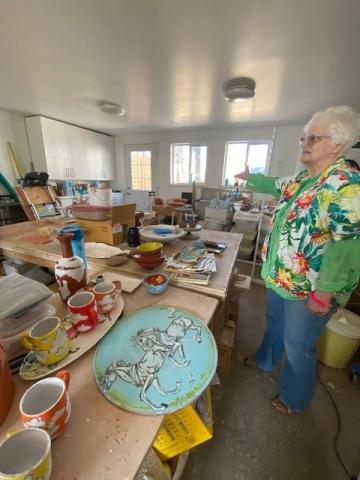
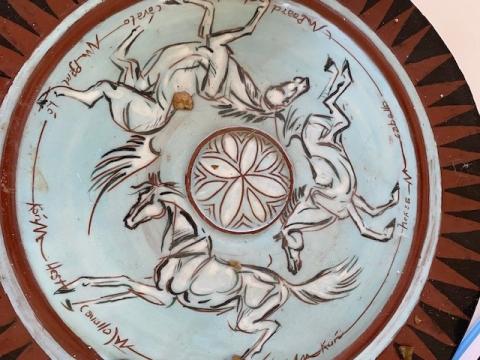
In her garage-studio—home to three kilns, a potters’ wheel and shelves of plates, pots, mugs and vases in various stages of completion—one central theme emerges: horses. Sometimes they are etched into clay, other times, painted or glazed onto the surface.
“Horses gave civilization to humanity,” the former president of the Alberta Potters’ Association says matter-of-factly. “There is a huge shopping list of what horses have done for us: they’ve been food, transport, they’ve pulled our carts and chariots and been beasts of burden. And for part of my life, I was lucky enough to own three.”
Her first was Candy, who taught Smith that “some horses want nothing to do with people.” Next was Sheba, a pony-sized, Anglo-Arab horse whom she describes as “the sweetest horse ever.” Then there was Koko, a saddle-bred Arab cross, “the most elegant horse I’ve ever met. Koko was the kind of horse, who wanted to say ‘let’s go.’ Honestly, she made me want to see the world.”
That lifelong passion also shaped her professional life. Over the years, Smith contributed to and edited equestrian publications such as Alberta Bits while building a business in communications alongside her late husband, PR wiz, Don Smith.
The couple worked in the oil and gas sector, a path that took them from Ontario to Fort McMurray where they lived for two winters. “Fort Mac was astonishing,” she recalls. “To see the ice break up on the Athabasca River, to feel the bitumen under your toes, to watch the sun come up like a little apricot.” Eventually the couple who met in Toronto in the 1970s settled in Calgary and later launched their own communications company, Smith PR. Years after, that company evolved into Visions West Marketing, which Smith ran for 20-odd years.
Pursue handmade imperfections
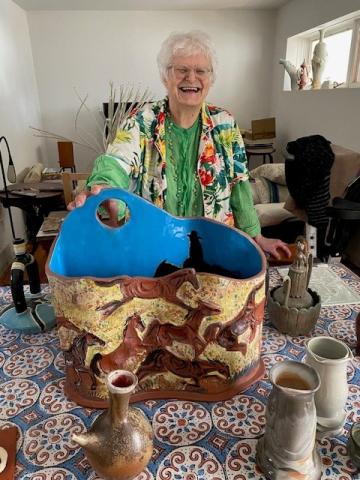
After Don’s death in 1998, Smith continued working until 2007, when she made a pivotal decision: to return to school. She arrived at ACAD as the oldest student in her class—and discovered a new artistic home in ceramics, along with what she calls “some extraordinary instructors and guest lecturers.”
She recalls a visiting scholar with a PhD in carpets, who spoke of the subversiveness of art, and the architect-turned-ceramicist, Hide Ebina, who had a deep fascination for porcelain and celadon glazes who became Smith’s mentor. “The conversations about art and history and ideas were so expansive and satisfying,” says Smith. “What ancient people did with clay—the origin of things—it caused so many flips and firings within my brain. And they’ve endured.”
That enduring impact is precisely why Smith has chosen to leave AUArts a transformative legacy gift—her estate.
“For me, art is about the heart, mind and body,” she says, surveying her studio where all her pieces suddenly look somewhat political, a little defiant. And in a way they are—handmade, some might say imperfect … it’s as though each item has taken a stand against mass production, polished perfection. “The body has to do the doing. The heart has to be about something within and the spirit takes one outside of oneself,” says Smith. “I love art with layers of meaning, the sort that makes me return to a piece and ask ‘what changed for me’ … ‘what is different now?’ Having the capacity to support artists—real, living, breathing artists—is crucial if we are going to continue to advance as humans.”
Perhaps this desire to give back has roots far deeper than her garden or her art (sometimes they are indeed one and the same)? Smith was born in Austria before her family immigrated to Sudbury where she grew up—an upbringing that seems worlds away from art schools and galleries, yet perhaps that explains her lifelong attraction to outsiders, makers and rebels.
Says Smith: “I hope this gift will lead to a blossoming of ideas or clarifying a vision. We have so many more choices than ever to work with and I’m always excited by artists who look around with fresh eyes …. from digging their own clay to firing cosmetics in order to understand what those products are made of. I loved those classes.
“Being in a community of artists at ACAD was so wonderful,” she says wistfully. “I learned things I could not imagine and was introduced to ideas and expertise that left me … well, in awe of the possibilities.”
Smith has been a generous supporter of AUArts, with philanthropic support spanning 15 years. Having experienced firsthand the impact of an arts education, she now hopes to create similar opportunities for emerging artists. Her own studies, and experiences at AUArts, deepened not only her ceramics practice but her confidence, curiosity and sense of possibility.
Smith’s long-term commitment to supporting AUArts students is now blossoming into a broader legacy. Through her estate planning, Smith has made a transformational bequest to help inspire and support the next generation of creatives. This gift commitment to AUArts’ Centennial Scholarships initiative will offer future students significant financial support and the freedom to experiment and explore the possibilities of their creativity.
“Over the years, I’ve been able to meet so many talented students,” she says. “I’d like to think my contributions enable them to take full advantage of everything AUArts has to offer.”
Smith’s limitless curiosity and passion for building community are reflected in how she has cultivated ways for other artists to grow their own creative practice. She has transformed the future of student awards at AUArts through her generosity and created opportunity for creativity to thrive. In Smith’s world, art is never static. It’s fired, broken, remade, questioned and passed forward.
In Smith’s world, art is never static. It’s fired, broken, remade, questioned and passed forward.
By supporting students through Centennial Scholarships, donors like Monika are preparing the next generation of creative leaders and innovators.